
Two minutes to say goodbye
How do you squeeze a lifetime of love into one short call?

I wasn’t there when she had the first terrible accident.
The one which saw her crawling through shattered glass in the dark of a bitingly cold November night. Mum had made it on her hands and knees through the back door of the house in which she’d lived for nigh on 50 years, further still through the length of the utility room, past the washing machine and the dog’s bowls and her rubber garden clogs, and into the kitchen.
There, she’d collapsed on the tiled floor where my brother found her. Hours later? We can only guess. If he’d assumed she’d gone to bed early when his calls went unanswered. If she’d been lying there until morning. If she never made it back into the house and had lain outside on an English winter’s night, all night. If.
A simple trip to put the bins out by the road, ready for collection, had ended in a confused old lady being carted off to hospital, never to return to have her morning coffee on the bench by the cherry tree in her beloved garden. She’d never tend to her prized rose beds again, nor watch the sun slip behind the wheat fields that bordered the house.
But my mum was tough. A child of the Blitz. An evacuee at the age of eight who was sent off by train from all she’d ever known in London to strangers in the countryside, a name label pinned to her navy woollen coat (“like a parcel”). Not for long did she stay there.
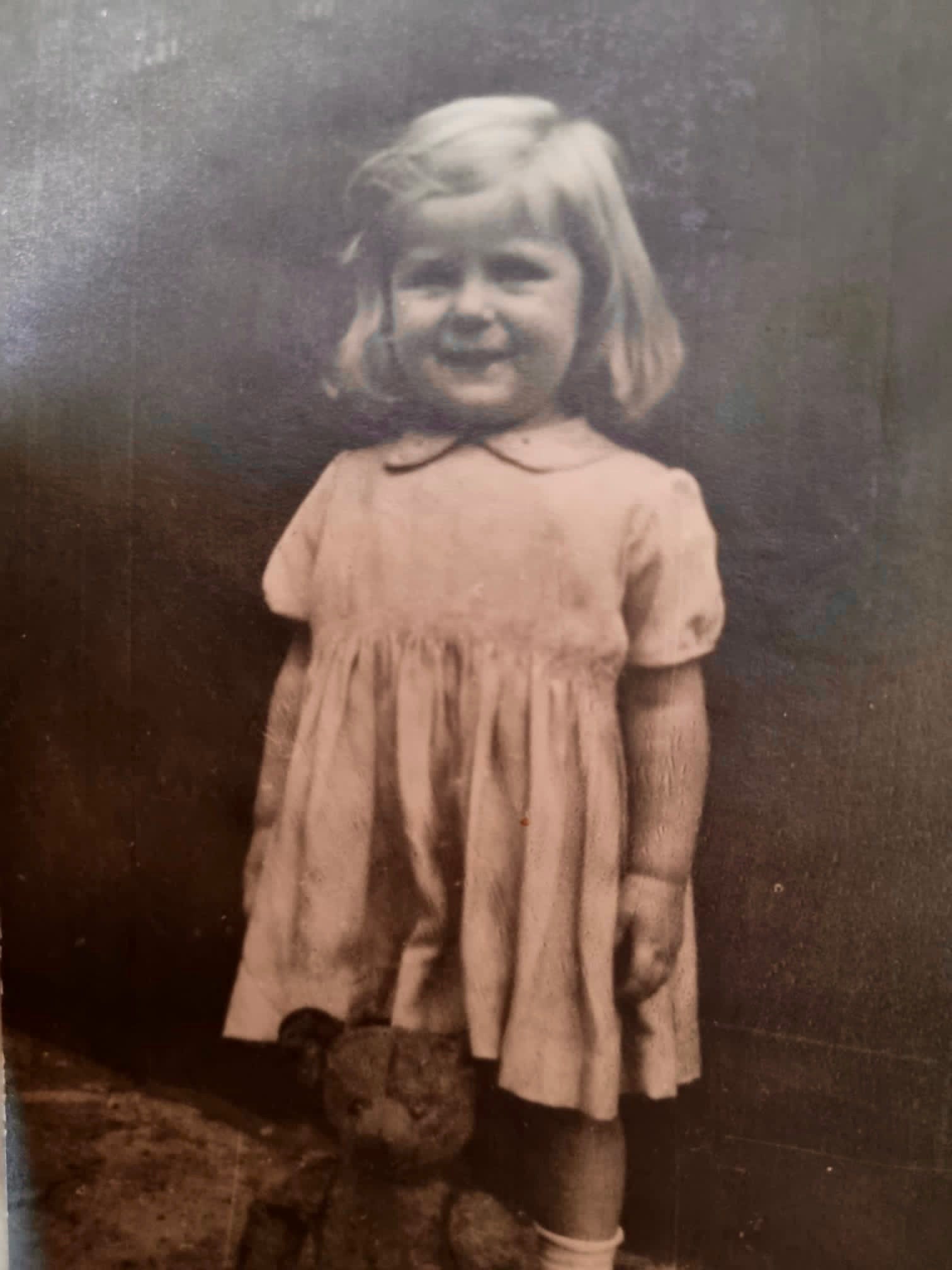
Mum begged my grandmother so much to let her return to the night-time bombing raids and the rockets and the devastation and the death, that she’d soon returned to London. She’d spent the rest of the war watching dogfights in the sky and picking her way to school through the rubble, only to run back home as soon as the air raid sirens began their wail.
Her knees had weakened, her resolve never had
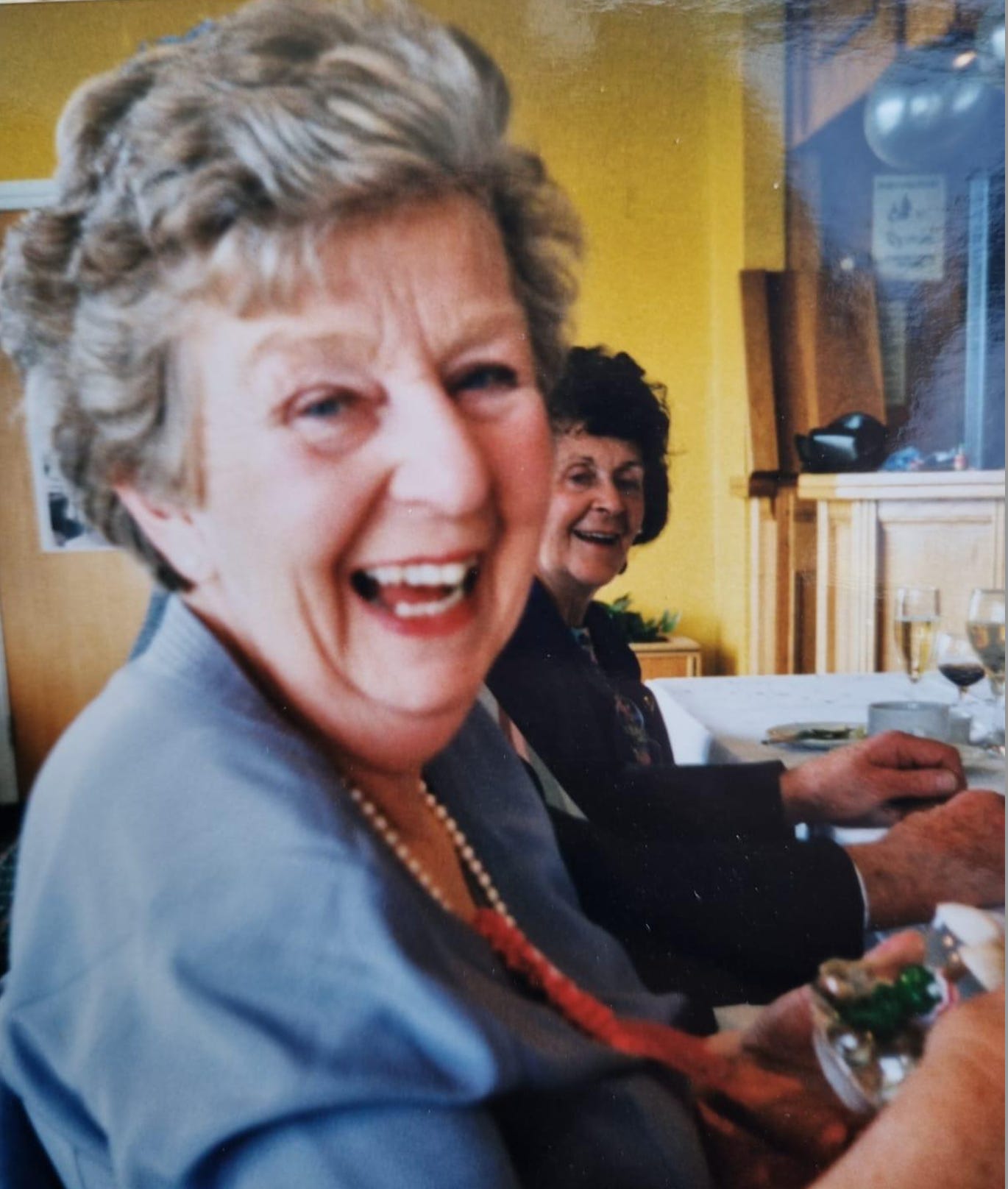
Now, at 88, this vibrant, determined, stubborn woman, the caregiver to so many, expert cuddler of grandchildren and dogs and cats, with her perpetual pearls and Calypso Coral lipstick, and a repertoire of solid English fare (all beef roasts and windfall apple crumbles), became the reluctant recipient of care herself.
Much later, I found out that while Alzheimer’s had strengthened its grip and her knees had weakened, her resolve never had. She’d been crawling upstairs to bed and bumping her way down on her bottom each morning, rather than give in. (“There’s life in the old girl yet.”)
Give in to what, I don’t know for sure. Not a stairlift for that would ruin how her hall looked. Not to a bedroom downstairs for that would take up a sitting room and certainly not care workers coming in. (“They might go through my things.”)
The call to tell me about Mum’s accident came early in the Australian morning. I’d woken to a stream of WhatsApp messages. She was in hospital. She should survive but she wouldn’t be going home. Arrangements had to be made. I was acutely aware that I wasn’t there to help make them. Family dynamics meant I had to stay in Australia, phoning every day as I had for as long as I could remember but still, not with her. It was a role reversal of care which had got stuck somewhere along the 17,000 km which separated us.
It wasn’t the first time I hadn’t been there for Mum and it wouldn’t be the last.
I hadn’t been there when she fell while walking her dog in the fields behind the house. Eventually, another walker had found her and helped her bruised and battered body home. I hadn’t been there when her she took out the wall on the driveway in her car. She hadn’t wanted me to know about either incident, had been annoyed when I’d found out. I guessed it was out of fear, afraid that each time something happened, it was a step closer to losing the self-determination which she guarded so fiercely.
We fall into the lifetime positions we hold in our families
But it was obvious what was happening, what needed to happen. And yet… I make no excuses for this – we fall into the lifetime positions we hold in our families and hard conversations and even harder decisions are neither had nor made. Until there comes the time when those decisions which we were too blind or weak to see are forced upon us by near tragedy.
I’d first left Mum at 18. I was off for a lifetime of adventures, none of which included the rural county in which I’d been born and raised. She cried at the airport, hiding her tears behind sunglasses. I cringed. Why was she sniffling? I’d only ever seen her cry twice and didn’t want this to be the third. Why did she want photos of me with my rucksack by the front door and on my back, posing with the ancient family dog?
With the cruelty of youth, I hurried through Departures and didn’t look back. No more bombing through the country lanes in Mum’s runaround to meet friends at the pub by the Deben. I left Suffolk’s high hedges and tractors and its smell of sugar beet behind. I left her too.
Over the years since then, living in two hemispheres and four countries, I’ve found myself perpetually stuck in the middle of the ocean which separates the home of my birth from the home I’ve made with my husband and sons. The pull from one to the other ebbs and flows with time and circumstance. In calm times, I bob about in the middle. At others, the tug of ties back home (and yes, it will always be ‘a’ home, even if it’s not ‘the’ home right now) leaves me rolling in the surf, not knowing up from down, choking and spluttering for air.
Births, marriages, christenings, cancer diagnoses, deaths… Whenever a particular moment demands I should be in one country, I’m rarely ever there.
We’re the sandwich generation but doing it remotely
Of course, I’m not the only one. More than 30 per cent of Australians were born overseas. At times, it seems that most of them (us) appear to be in and around the Northern Beaches of Sydney to where I came 19 years ago. What started as a 12-month stint for work stretched on and here we still are.
Conversations with expat friends now almost always turn to the parents we left behind. We’re the sandwich generation but doing it remotely. ‘It’ being caring for teens while worrying about aged parents back home, wherever in the world home might be, and trying (failing?) to provide the care they need – the care they deserve.
Leaving a spritely, feisty, sociable mum behind when they’re just past 70 becomes a whole different matter as time speeds up and the face (well, actually it was usually Mum’s ear as she never quite got the hang of Facetime) wizens.
The next time you see them in person, time has sped up and your parent is now properly, officially old. Their bodies shrink along with their worlds so that a trip to the local shops becomes the most they can deal with on any given day, and the family friends who provided the framework to your childhood die off until they are suddenly the last (wo)man standing.
"I never turn my phone off at night,” my friend Josie reports. “It used to be because of my teenagers when they were out late at night. Now it’s because Mum and Dad might need me.”
The fact that her parents are in Johannesburg and whatever they might need in the middle of the night is not something Josie will be able to help them with in good time does not escape her, nor me. But I get it. Nothing good comes from a call that jolts you awake in the darkness but still, we keep our phones on. Just in case.
“I imagine my sons will end up living all over the world,” comments another friend, Karen. “Certainly not near enough for me to play any meaningful part in the lives of any grandkids or to help me out when the time comes but how can I complain? That’s exactly what I did to my own parents.”
I’d never wished for something more but wanted it less
It was two and a half years after the accident and in the first days of December that Mum finally began to give in. I’d never wished for something more but wanted it less. And yet again, I wasn’t there.
After so many false alarms and drawn out visits home thanks to a job which allowed me to work from my laptop in the country house care home in which she lived, in the end it was quick. So quick that I knew I wouldn’t make it back in time to hold her hand and tell her in person what I needed to say and she needed to hear.
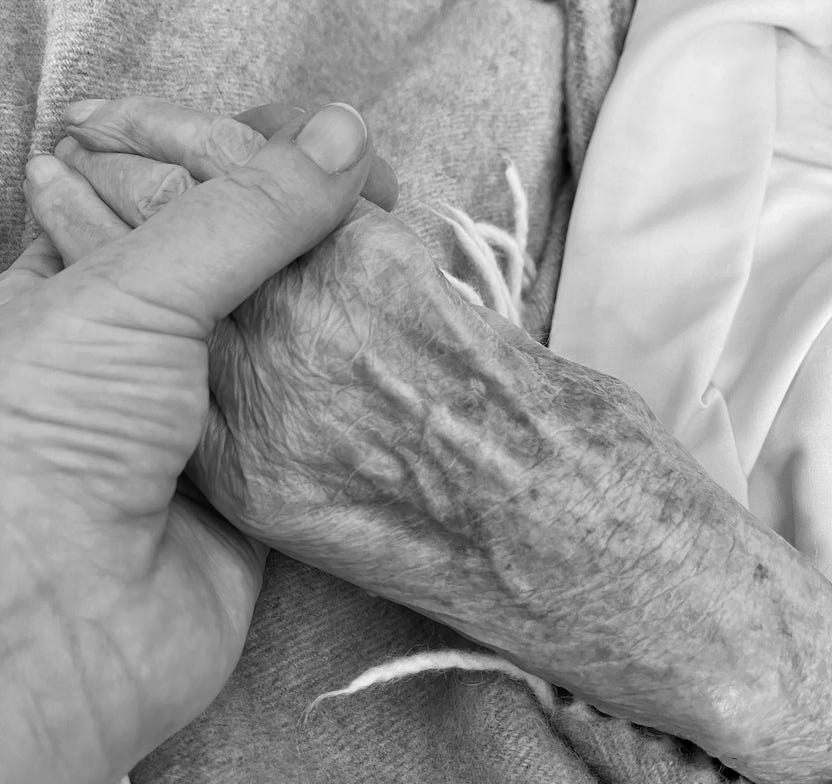
My turn to say goodbye came in the form of a phone call. My brother held his phone to her ear as I spoke.
I knew Mum needed permission to let go and I knew she would need to be alone when she did. I knew it had to be her decision (“Don’t rush me. Let me do things in my own time.”) and I knew she’d feel happier leaving if she had a job to do, something which only she could do. I knew immediately what that job would be. For all the years of distance, I am my mother’s daughter. I knew.
So I told her. In two minutes I told her all the things knowing that no length of time and no amount of words would ever be enough.
I told her that everyone was safe and well. That she was so loved by us all and that we had all been loved by her in return. That if she wanted to, when she, and she alone, decided, it was OK to go. That my dad was waiting for her, her mum was waiting for her too and that I had a job I needed her to do.
I’d had twin daughters years before who’d died an hour after birth.
“I need you to look after the girls for me, can you do that? They need their grandma.”
It was her belief system, not mine but if it helped her take the final step, so be it.
I’m told her hands flickered as I spoke.
“I’d pick you again in a heartbeat, Mum.”
I cut the call and sobbed.
True to form, she died without fuss or fanfare, on her own terms and by herself, around dawn, two days later.
Time marches on but doesn’t always give up the answers we crave
The enormity of carrying Mum’s coffin to her favourite Callas aria hit me on the day of her funeral. Despite the fact that she weighed no more than a fledging when she died, the oak was heavy and my shoulder burned with the weight. I wanted to feel that weight and that pain. As a penance, an apology? Something else to be unpacked in time, I guess.
So, now as I type, her bottle of Youth Dew (“Well, it doesn’t ruddy work, does it?”) sits on my desk, a tube of Calypso Coral in the drawer. It’s the little I have left of her and on the days I need strength and comfort, I wear them both.
My brothers gathered on Friday to inter Mum’s ashes at the foot of her parents’ grave. Seven months after her death, the chapter has been closed.
I saw the pictures when I woke. The grave untended, overgrown. Devoid of flowers, even the old tree which had provided a canopy of green shade in the summer and frozen beauty in the snow, now merely a stump in the background. Time marches on but doesn’t always give up the answers we crave.
All I know is that I wasn’t there.

Ruth, stumbled across this. So beautifully written ❤️ Already in tears so can’t bring myself to listen to the message yet…
It’s not very fair, this getting old business. For anyone. Beautifully written.